

What Just Happened?
In one of the most significant legal developments for Pakistan’s real estate sector in recent years, the **Federal Constitutional Court (FCC)** — led by Chief Justice Aminuddin Khan and Justice Ali Baqar Najafi — has officially struck down **Section 7E of the Income Tax Ordinance, 2001.**
The court declared the provision **ultra vires** the Constitution, meaning it exceeded the lawful authority of Parliament. More importantly, it ruled the provision to be **void from day one** — as if it never legally existed.
All notices, proceedings, and tax recoveries carried out by the **Federal Board of Revenue (FBR)** under Section 7E are now declared unlawful and without legal authority.
What Was Section 7E?
Introduced through the **Finance Act 2022** for tax year 2023, Section 7E imposed a tax on **deemed or notional income** from immovable properties. The law assumed that any property you own — even if it generates zero actual rental income — is earning you money, and taxed it accordingly.
Under this provision, the FBR treated **5% of a property’s assessed fair market value as taxable income**, effectively resulting in an annual levy of roughly 1% on the capital value of covered properties. It applied to residential, commercial, and under-construction properties alike — targeting assets valued above **Rs. 25 million**, with a limited exemption for one self-occupied residential property.
The government was essentially taxing **imaginary income** — penalising property owners for simply owning an asset, rather than taxing any real earnings derived from it. Property owners and developers across the country strongly opposed the law, arguing it created economic disincentives for investment, slowed development activity, and unfairly burdened genuine taxpayers. 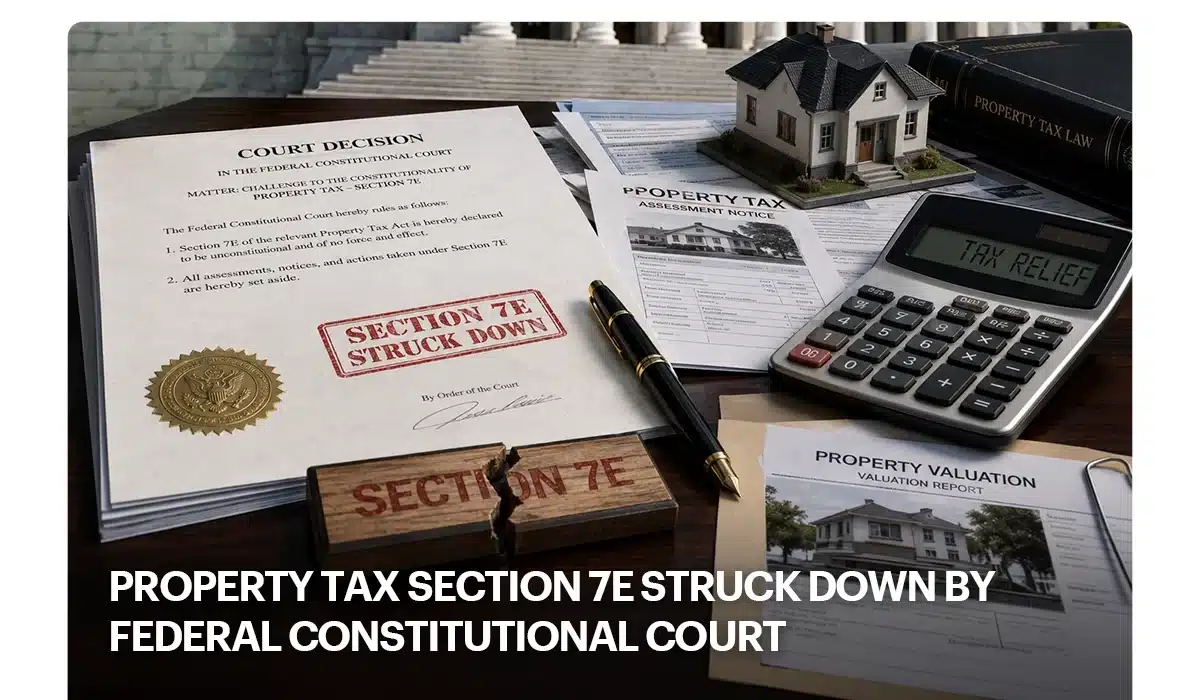
How Did the Courts Rule? — A Timeline of Legal Battles
Before reaching the FCC, Section 7E faced legal battles across multiple high courts — with contradictory outcomes that created widespread confusion in the real estate market:
**Peshawar High Court** — Declared Section 7E unconstitutional and struck it down.
**Balochistan High Court** — Also declared the provision unconstitutional.
**Islamabad High Court** — Did not invalidate it entirely but declared Subsection (2) ultra vires the Constitution.
**Lahore High Court** — Initially upheld the provision as constitutional, but the ruling was later reversed by a division bench.
**Sindh High Court** — Had dismissed petitions challenging the provision.
Due to these conflicting judgments across the country, the matter was transferred to the **Federal Constitutional Court** for a final, binding determination. The FCC reserved its verdict on April 30 and issued the short order shortly after.
Final Verdict — Federal Constitutional Court:**
Section 7E is unconstitutional, void ab initio, and struck down entirely. All FBR actions, notices, and proceedings under the provision are nullified. FBR appeals for reinstatement are dismissed.
—
What Does This Mean for You?
**Tax liability eliminated.** Property owners who were previously liable under Section 7E — particularly those holding assets above Rs. 25 million — are now fully relieved of that burden.
**FBR notices are void.** Any tax notice, demand, or recovery initiated under Section 7E by the FBR is now legally ineffective and unenforceable.
**Refunds may be possible.** Since the court declared the provision void from the very beginning, taxpayers who paid under Section 7E may have grounds to seek refunds — though this will require individual legal proceedings.
**Commercial property investment boost.** With this tax removed, commercial real estate in Islamabad and across Pakistan becomes a significantly more attractive asset class for both local and overseas investors.
**Under-construction projects relieved.** Developers and builders burdened by the Section 7E levy on incomplete projects can now redirect those resources toward accelerating construction timelines.
**Renewed investor confidence.** The ruling reinforces constitutional protections for property owners, signaling to the market that speculative or overreaching taxation will not stand.
—
The Legal Principle at the Heart of This Ruling
The FCC’s decision rests on a fundamental constitutional principle: **income tax can only be levied on actual, realized income** — not on presumed or hypothetical earnings from an asset you simply own.
Advocate Zainab Janjua, commenting on the verdict, stated:
*”The Constitution very clearly ousts taxation on immovable properties from the purview of the federal legislature. The provision, by creating a legal fiction of deemed income, indirectly sought to do what the Constitution did not permit directly.”*
She further noted that Section 7E was discriminatory in its application — squeezing documented taxpayers who purchased properties through declared earnings, while government officials allotted subsidized plots at nominal prices remained excluded from its scope entirely.
Estate Tune’s Take — What This Means for Islamabad’s Commercial Market
At **Estate Tune**, we have been closely tracking this case since it began working its way through the courts. We have seen firsthand how the Section 7E burden dampened investor appetite — especially in Islamabad’s commercial corridors, where buyers were hesitant to acquire larger portfolios due to recurring deemed income tax pressure.
This ruling is a **game-changer for the Islamabad commercial property market.** We anticipate a noticeable uptick in transaction volumes, particularly for:
– Commercial plazas, shop floors, and office units in key sectors
– High-value residential properties being considered for portfolio investment
– Under-construction commercial projects that were previously burdened
– Overseas Pakistani investors reconsidering real estate as a primary asset class
If you have been waiting on the sidelines due to tax concerns — **now is the time to reassess your investment strategy.**
—
Final Word
The Federal Constitutional Court’s ruling on Section 7E is not just a legal milestone — it is a strong signal that **Pakistan’s constitutional framework protects property owners from arbitrary and unconstitutional taxation.** For investors, developers, and homeowners alike, this verdict removes a significant financial burden and restores confidence in the real estate sector.
At Estate Tune, we are here to help you make the most of this renewed opportunity — whether you are looking to invest, buy, or expand your commercial property portfolio in Islamabad.
—
*This blog is published by Estate Tune for informational purposes. For personalized legal advice regarding Section 7E tax refund claims or FBR notices, please consult a qualified tax attorney.*
—
**🏢 Estate Tune — Islamabad’s Trusted Commercial Property Partner Since 2012**
📞 +92 300 855 63 88 | +92 333 022 0666
🌐 www.estatetune.com
Related reading
- Islamabad Commercial Property Market Report: October 2026
- If Your Business Were a Person — What Would Its Ideal Neighborhood Look Like?
- This Month’s Biggest Commercial Property Mistake We Saw in Islamabad — And the Lesson
Looking for commercial space in Islamabad? Browse current listings or contact our team.