An Estate Tune Startup Edition | Helping Islamabad’s Next Generation of Businesses Find Their Home
Introduction
Every great business that exists in Islamabad today started as an idea. Someone sitting at a kitchen table, a university café, a bedroom desk, or a co-working hotdesk had a vision of what they wanted to build — and at some point in that journey, the question moved from what to build to where to build it.
Finding your first commercial space is one of the most consequential decisions a startup makes. Get it right and your office becomes an asset — a space that attracts talent, impresses clients, reflects your culture, and grows with your ambitions. Get it wrong and your office becomes a liability — draining cash, constraining your team, and creating operational headaches that pull your focus away from the work that actually builds your business.
The challenge for Islamabad’s growing startup community is that most of the guidance available about commercial property in Pakistan is written for established businesses with predictable revenue, stable headcounts, and long-term location certainty. Almost none of it addresses the specific realities of a startup — variable cash flow, uncertain growth trajectories, evolving space requirements, sensitivity to monthly overhead, and the critical importance of being in the right location to attract the right people.
This guide fills that gap. It is written specifically for founders, early-stage teams, and entrepreneurs who are navigating Islamabad’s commercial property market for the first time — and who need practical, honest, experience-based guidance rather than generic real estate advice dressed up in startup language.
At Estate Tune, we have worked with dozens of Islamabad’s emerging businesses to find their first and subsequent commercial homes. Everything in this guide reflects what we have learned from those conversations and those transactions — the mistakes we have seen, the decisions that worked out brilliantly, and the principles that consistently separate startups that find great spaces from those that settle for inadequate ones or overcommit to expensive ones.
Part 1 — Before You Start Looking
The Thinking That Has to Happen Before the Search
The most common mistake startups make in their commercial property search is starting too early — beginning to look at spaces before they have answered the fundamental questions that determine what kind of space they actually need. This leads to a search that is unfocused, inefficient, and frequently ends in a decision driven by the attractiveness of a particular space rather than the fit between that space and the business’s actual requirements.
Before you visit a single property or speak to a single agent, spend serious time with your co-founders answering these questions honestly and specifically.
How many people do you actually need to accommodate right now?
Not your hiring plan for the next three years. Not your optimistic projection of team size if everything goes perfectly. The actual number of people who will be working from this space in the first six months of the lease. This number determines your minimum viable space requirement and is the foundation of every subsequent space decision.
The general benchmark for office space planning is 80 to 120 square feet per person for a reasonably comfortable working environment — though open plan collaborative spaces can be designed at lower densities and private office configurations typically require higher per-person allocations. Use this benchmark to translate headcount into minimum square footage and you have your first hard constraint.
How important is your office address to your business identity?
This question is more strategically significant than it first appears. For some startups — those serving corporate clients, those whose perceived credibility is critical to their sales process, those operating in sectors where location prestige signals quality — a Blue Area or F-7 address is not a vanity expense but a genuine business asset that pays returns through client acquisition and talent attraction.
For other startups — those operating in sectors where their product quality speaks for itself regardless of address, those whose client interactions are primarily digital, those in early stages where cash conservation is the absolute priority — a prestigious address is a genuine luxury that redirects resources away from more impactful uses.
Be honest about which category your business falls into. A startup that convinces itself it needs a Blue Area office when it actually needs six months of runway is making a decision that prioritizes appearance over survival.
What does your team actually need from their working environment?
Different businesses have fundamentally different spatial requirements that are easy to overlook in the excitement of finding a space. A software development team needs quiet, focused working environments with excellent internet connectivity and minimal interruption. A creative agency needs collaborative open spaces, good natural light, and room for visual material display. A sales-driven business needs comfortable client meeting facilities and phone booth or private calling spaces. A hardware or product company may need workshop space, storage, and loading access that standard office units cannot provide.
Map your team’s actual working requirements before you start looking — and filter every property you consider against that map rather than against generic office space attractiveness.
What is your honest monthly budget for office costs — all in?
Not what you wish your office costs could be. Not what you could afford if your next funding round closes on time. Your actual current monthly budget for total occupancy cost including rent, utilities, internet, maintenance charges, and any service fees. This number should be established before the search begins and treated as a hard constraint rather than a starting point for negotiation with yourself.
A useful benchmark for startup office spending is 10% to 15% of current monthly revenue or runway allocation — though this varies significantly by stage, funding status, and business model. Spending significantly above this threshold on office costs in early stages creates a fixed overhead burden that constrains your ability to respond to the inevitable surprises and pivots that characterize startup life.
Part 2 — Understanding Your Commercial Space Options in Islamabad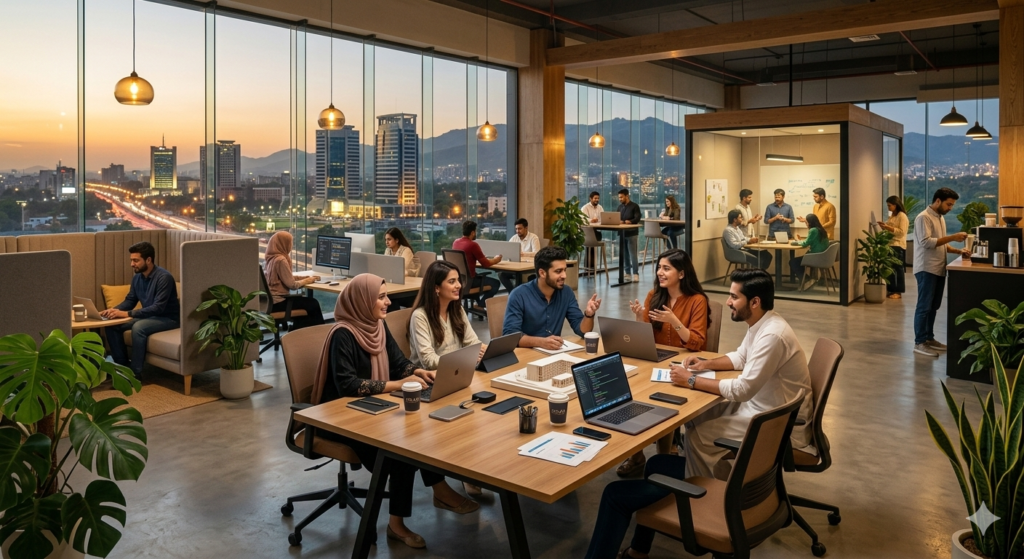
The Full Spectrum From Co-Working to Dedicated Office
Islamabad’s commercial space market offers startup founders a broader range of options than existed even five years ago — and understanding the full spectrum of available options is essential to making the right choice for your specific stage and situation.
Option 1 — Co-Working Spaces
Co-working spaces have established themselves as a genuine and growing part of Islamabad’s commercial ecosystem over the past several years — and for early-stage startups they represent often the most financially intelligent and operationally flexible commercial space solution available.
The co-working model offers startup founders access to professional workspace, high-speed internet, meeting room facilities, printing and administrative infrastructure, and often a community of fellow entrepreneurs — all on flexible membership terms that can be adjusted monthly as team size changes.
Islamabad’s co-working landscape includes options at different price points and with different community characters — from premium spaces in central locations with polished amenities and corporate co-tenants to more affordable community-focused spaces that prioritize entrepreneurial community over premium infrastructure.
What co-working is right for: Pre-revenue and early revenue startups that need to conserve cash, teams of one to five people whose space requirements may change rapidly, founders who value the networking and community dimensions of shared workspace, businesses that need a professional address and meeting facility without the overhead of a dedicated office, and startups in their first six to twelve months who are still validating their business model and cannot yet commit to the fixed costs of a dedicated space.
What co-working is not right for: Teams that require confidential working environments, businesses with sensitive client data handling requirements, teams larger than eight to ten people where co-working becomes less cost-efficient than dedicated space, businesses that need to customize their environment for specific operational requirements, and companies whose brand positioning requires a dedicated, branded office presence.
Option 2 — Serviced Offices
Serviced offices offer a middle ground between co-working flexibility and dedicated office permanence — providing fully furnished, IT-equipped, and managed private office units available on flexible terms that typically range from one month to one year.
The serviced office model eliminates the capital investment required to fit out a raw commercial unit — furniture, IT infrastructure, air conditioning, and building management are all included in the monthly fee. This makes serviced offices particularly attractive for startups that need private dedicated space but cannot or should not commit significant capital to fit-out investment at an early stage.
Islamabad’s serviced office market is growing but remains less developed than co-working — with the best options concentrated in central commercial locations. Monthly costs are higher than co-working but significantly lower in total than the combined cost of raw office space plus fit-out plus ongoing management.
What serviced offices are right for: Teams of five to twenty people who need dedicated private space, startups that have moved beyond the co-working stage but are not yet ready for a long-term raw office commitment, businesses with client-facing operations that require a professional private environment, and companies that want to scale up or down their space allocation with minimal friction.
Option 3 — Raw Commercial Units on Lease
Raw commercial units — unfurnished, unfinished commercial spaces leased directly from landlords on traditional lease terms — represent the most significant commitment and the highest potential reward in Islamabad’s startup commercial space spectrum.
Leasing a raw commercial unit gives your startup complete control over its working environment — the layout, the finish quality, the brand expression, and the spatial configuration all reflect your choices rather than a landlord’s or co-working operator’s standard template. This control matters more as your team grows and your culture becomes a genuine competitive asset in talent attraction.
The challenges of raw commercial leasing for startups are real and should not be minimized. Fit-out investment — transforming a bare commercial unit into a functional, comfortable working environment — requires capital that early-stage startups may not have or should not spend. Traditional lease terms of one to two years with significant security deposits create financial commitments that can constrain startup flexibility. And the management overhead of operating your own commercial space — dealing with utilities, maintenance, building management, and landlord relationships — diverts founder attention from business building.
What raw commercial units are right for: Startups that have achieved meaningful revenue and have capital available for fit-out investment, teams of fifteen or more people where the economics of dedicated space become compelling relative to co-working or serviced office alternatives, businesses whose culture, client experience, or operational requirements genuinely require a fully customized environment, and companies at a stage where the long-term commitment of a traditional lease aligns with their business confidence and growth trajectory.
Part 3 — Location Analysis for Islamabad Startups
Where to Set Up and Why It Matters More Than You Think
Location is the commercial property decision that is most difficult to reverse and most consequential for startup success — and it deserves significantly more analytical attention than most startup founders give it before committing to a space.
The Talent Catchment Consideration
For knowledge economy startups — technology companies, digital agencies, creative businesses, professional services firms — the single most important location factor is access to the talent pool you need to hire from. In Islamabad’s context, this means understanding where your target employees live and how your office location affects their willingness to join your team and their ability to get to work without unreasonable commuting burden.
Islamabad’s tech and creative talent is heavily concentrated in the F and G sectors, in DHA, in Bahria Town, and in the newer sectors along the city’s northern and eastern periphery. An office location that requires a ninety-minute commute from where your target engineers or designers live is an office that will cost you talent — invisibly and continuously — in ways that are never captured in your occupancy cost calculation but are very real in their impact.
The Client Accessibility Consideration
If your business involves regular client visits to your office — pitching new clients, hosting ongoing client meetings, or operating in a sector where office visits are part of the client relationship — location visibility and accessibility become important commercial factors rather than just logistical preferences.
For startups serving corporate clients in Islamabad, a Blue Area or F-7 address communicates professionalism and accessibility to the client base most likely to be located in those zones. For startups serving a broader or more diverse client base, accessibility from multiple directions via Islamabad’s improving road network may matter more than address prestige.
The Ecosystem and Community Consideration
One of the most underappreciated location factors for early-stage startups is proximity to the entrepreneurial ecosystem — investors, mentors, fellow founders, accelerators, and the informal network of people and institutions that support startup growth.
Islamabad’s emerging startup ecosystem is not yet as geographically concentrated as Lahore’s or Karachi’s — but meaningful clusters of entrepreneurial activity have developed around certain locations including NUST and other university adjacent areas, the PITB and IT park zones, and the co-working hubs that serve as informal community centers for the city’s startup scene. Being physically proximate to these clusters creates networking, partnership, and learning opportunities that are genuinely valuable for early-stage founders.
Zone by Zone Analysis for Islamabad Startups
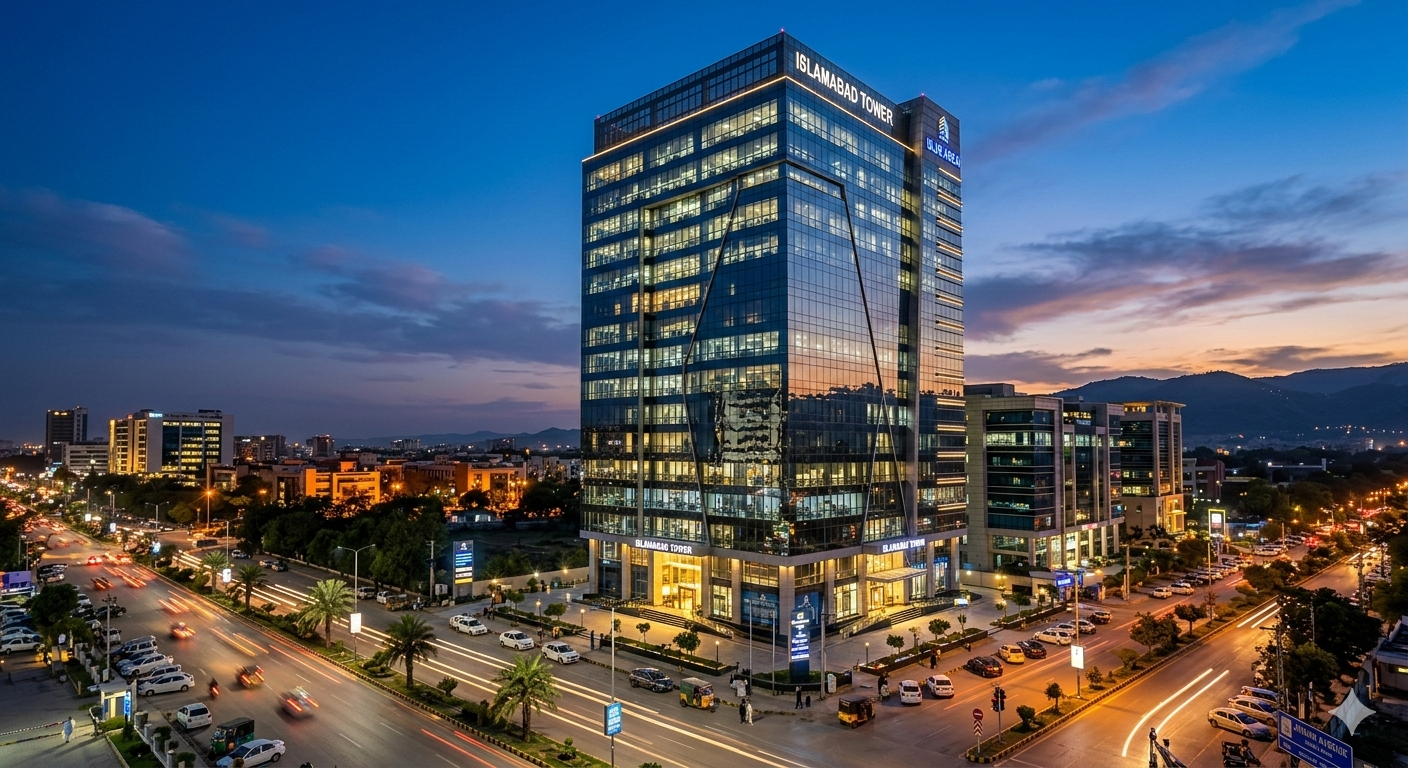
Blue Area is the right choice for startups that genuinely need maximum corporate credibility and client accessibility — particularly those in financial services, consulting, government contracting, or other sectors where Blue Area presence signals tier and seriousness. The cost premium is real but so is the commercial return for the right type of business.
F-7, F-6, and F-8 offer a combination of central location, premium retail and dining ecosystem, and lifestyle quality that makes them attractive for startups competing for top talent from Islamabad’s professional class. The premium dining, coffee, and social infrastructure in these sectors is a genuine talent retention asset that smart founders factor into their location decisions.
E-11 and adjacent sectors have emerged as a de facto tech district in Islamabad — with a growing concentration of technology companies, digital agencies, and startup-adjacent businesses that creates genuine ecosystem value. Rental rates are more accessible than Blue Area while connectivity to the city’s talent pools and the co-working and incubation infrastructure in the area is strong.
Gulberg Islamabad represents the most urban and integrated commercial environment available to Islamabad startups — with on-site retail, dining, and lifestyle facilities that create a genuine campus-like working environment. For startups whose culture and talent strategy aligns with urban lifestyle positioning, Gulberg offers a working environment that is genuinely differentiated.
G-9 and G-11 markaz areas offer more affordable commercial space options in well-connected locations that provide good access to Islamabad’s broader residential catchment without the premium pricing of more central locations. For startups where cost efficiency is paramount and address prestige is secondary, these areas deserve serious consideration.
Part 4 — The Lease Negotiation Playbook for Startups
How to Negotiate Commercial Leases When You Have Less Leverage Than Established Businesses
Startup founders entering commercial lease negotiations in Islamabad face a structural disadvantage — landlords prefer established businesses with stable revenue and demonstrable ability to meet long-term rental commitments over early-stage companies whose future is inherently uncertain. Understanding this dynamic and knowing how to navigate it is essential to securing terms that protect your startup’s flexibility and cash position.
The Lease Term Negotiation
Your primary objective in lease term negotiation as a startup is to minimize the commitment period while maximizing your option to extend if the business performs well. Standard commercial lease terms in Islamabad run for one to two years with renewal options — but landlords will often push for longer commitments if they sense a tenant’s enthusiasm for a particular space.
Resist the temptation to commit to longer lease terms in exchange for modest rental discounts. The value of preserving your startup’s flexibility to relocate, downsize, or upgrade as your business evolves is almost always worth more than the rental saving from a longer commitment. Negotiate hard for shorter initial terms — even six months with a renewal option is achievable with some landlords in Islamabad’s current market if you approach the negotiation correctly.
The Security Deposit Negotiation
Security deposits on commercial properties in Islamabad typically represent two to three months of rent — a meaningful capital requirement for cash-sensitive early-stage startups. While security deposits are a legitimate landlord protection mechanism, the amount is negotiable and some landlords will accept reduced security deposits from tenants who can demonstrate creditworthiness through alternative means — a personal guarantee from founders, a reference from a credible business connection, or upfront payment of the first three months of rent.
The Rent-Free Period Negotiation
Negotiating a rent-free period to cover your fit-out and setup time is standard practice in commercial lease negotiations and represents one of the most valuable concessions a startup can secure. Depending on the landlord and the condition of the space, a one to two month rent-free period for setup purposes is a reasonable and achievable negotiation objective that saves meaningful cash at the most sensitive point in your occupancy cycle.
The Rental Increment Clause
Every commercial lease in Islamabad includes an annual rental increment clause — typically 10% to 15% per year. While this clause is standard and expected, the specific percentage is negotiable. Securing a lower increment percentage — particularly in the first two years of a lease — is a high-value negotiation win for startups whose revenue growth may not keep pace with aggressive rental escalation.
Sub-Letting Rights
Negotiate explicit sub-letting rights into your commercial lease. This provision allows you to sub-let portions of your space to other businesses if your team size shrinks or if you take on more space than you immediately need — providing a safety valve against the financial impact of paying for space you are not fully utilizing. Many landlords will accept this provision with the qualification that sub-letting requires their prior written approval — which is a reasonable compromise that still gives you meaningful flexibility.
Part 5 — The Fit-Out Reality for Islamabad Startups
Making Your Space Work Without Breaking Your Budget
Fit-out — the process of transforming a raw commercial unit into a functional working environment — is the most consistently underestimated cost in Islamabad’s startup commercial space journey. Founders who budget carefully for their monthly rent frequently discover that the capital required to make their space actually workable is double or triple their initial estimate.
The Non-Negotiables
Certain fit-out elements are genuinely non-negotiable for a functional startup office and must be budgeted for regardless of how aggressively you are managing costs. Reliable high-speed internet connectivity with backup redundancy is the single most important infrastructure investment any knowledge economy startup makes in its office fit-out — and it deserves a budget allocation that reflects its business-critical importance.
Power backup capacity — whether through a dedicated UPS system, generator access, or solar integration — is an essential operational requirement in Islamabad’s current power infrastructure environment. A startup whose work stops every time the grid power fails is a startup that is spending a hidden tax on productivity that compounds daily.
Adequate cooling — either through existing building systems or independently installed air conditioning units — is a basic comfort and productivity requirement that cannot be deferred in Islamabad’s climate.
The Smart Investments
Beyond non-negotiables, certain fit-out investments consistently deliver returns in startup environments that justify their cost. Collaborative open workspace design — with flexible furniture configurations, writable wall surfaces, and easily reconfigured layouts — supports the iterative, collaborative working styles that characterize high-performing startup teams and allows your space to adapt as your team evolves.
A well-designed meeting room or client reception area delivers disproportionate return on investment for client-facing startups — creating a professional impression that supports your credibility narrative with potential clients and partners without requiring a prestigious building address to reinforce it.
The Intelligent Deferrals
Many fit-out elements that startups feel compelled to install immediately can be intelligently deferred without operational impact. High-end furniture can be replaced with functional alternatives that are upgraded as the business matures. Complex storage and filing infrastructure is rarely needed in a startup’s first year. Elaborate reception areas are unnecessary for businesses whose client interactions are primarily digital or who meet clients at client locations. Custom branding installations can wait until the business has established enough stability to invest confidently in permanent physical brand expression.
Budget Benchmark
A functional but not lavish startup office fit-out in Islamabad for a team of ten to fifteen people in a mid-market commercial location typically requires a budget of PKR 15 lakh to PKR 35 lakh depending on finish quality ambition, existing condition of the space, and specific operational requirements. This benchmark should be verified against current contractor quotes in your specific location and for your specific space — but it provides a realistic starting point for financial planning.
Part 6 — The Technology Infrastructure Checklist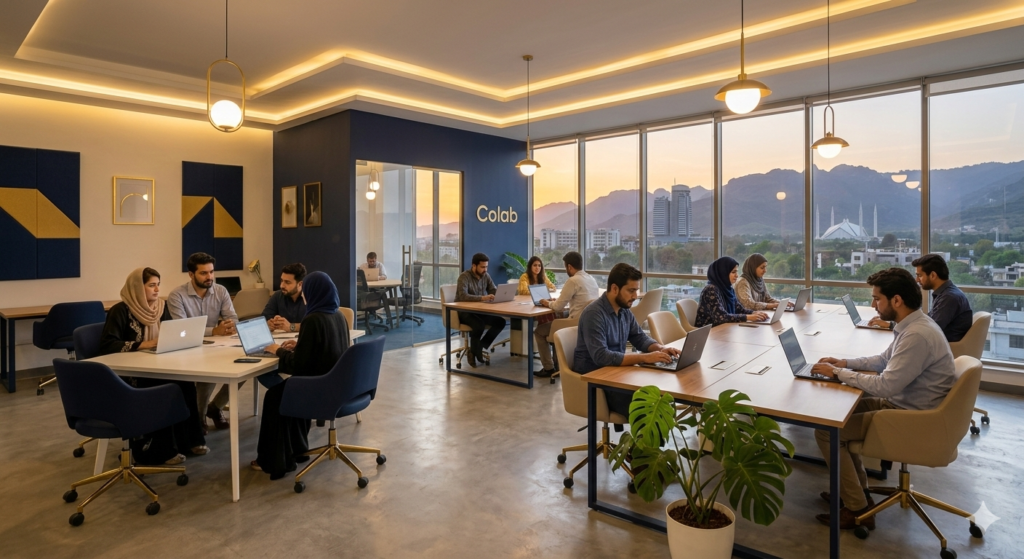
What Every Islamabad Startup Office Needs to Function at Full Capacity
Technology infrastructure is the dimension of commercial space preparation that startup founders are most qualified to assess — and yet it is frequently underplanned in the context of physical space selection and fit-out planning.
Internet Connectivity
Secure fiber optic internet connectivity as a primary connection with a separate backup connection on a different provider and different physical infrastructure. Single-provider, single-connection internet in a startup office is an unacceptable operational risk. The cost of dual connectivity is modest relative to the productivity cost of internet downtime for a team whose work is entirely digital.
Verify actual connectivity availability at your specific address before signing any lease — not all Islamabad commercial locations have equal fiber optic availability and the difference between an address with excellent connectivity and one with limited options can be commercially significant for technology-dependent businesses.
Power Management
Install a properly sized UPS system to protect critical equipment from power fluctuations and provide short-duration backup during grid transitions. For teams with consistent power requirements, explore the economics of on-site solar generation which has become increasingly accessible and cost-effective in Pakistan and which provides both backup power security and ongoing electricity cost reduction.
Network Infrastructure
Invest in quality internal network infrastructure — managed switches, quality WiFi access points with appropriate coverage for your space, and proper network segmentation that separates guest access from operational systems. Poor internal network infrastructure is a consistently underestimated productivity drain that compounds daily across your entire team.
Meeting Room Technology
Install quality video conferencing capability in your meeting room or client space. The hybrid and remote working reality of the modern business environment means that virtually every meeting involves at least one remote participant — and the quality of your video conferencing infrastructure directly affects the professionalism of those interactions.
Part 7 — Common Mistakes Islamabad Startups Make with Commercial Space
Learning from What Goes Wrong So You Do Not Have To
Overcommitting on Space Too Early
The most financially damaging commercial space mistake startups make is leasing significantly more space than they currently need on the basis of anticipated growth. Growth projections are inherently uncertain and the cost of carrying underutilized space — in both cash and management attention — is a concrete ongoing burden while the growth that was supposed to justify it remains theoretical.
Lease for your current confirmed headcount plus a reasonable growth buffer of twenty to thirty percent. Do not lease for your Series A hiring plan before you have raised your Series A.
Underestimating Total Occupancy Cost
Monthly rent is only one component of your total occupancy cost and frequently not even the largest one over the full lease term. Security deposit tied up capital, fit-out investment amortized over the lease term, monthly utilities, internet costs, maintenance charges, building fees, and the time cost of managing the space all add up to a total occupancy cost that consistently exceeds initial estimates by thirty to fifty percent.
Build your commercial space budget from a total occupancy cost perspective — not a headline rent perspective — before making any commitment.
Choosing Address Over Fit
The allure of a prestigious commercial address is real and understandable for ambitious founders who want to build impressive companies. But an impressive address that strains your cash position, requires a longer commute for your team, or puts you in a building that does not meet your operational requirements is a poor trade regardless of how good it looks on your email signature.
Choose the space that best fits your team’s needs and your business’s financial reality — not the address that most impresses people who have never visited and will only ever see it written on a document.
Skipping Professional Legal Review
The commercial lease agreement you sign is a legally binding document with significant financial implications that will govern your relationship with your landlord for the entire term. Having a qualified property lawyer review this document before signing is not an optional expense — it is essential protection against provisions that could damage your business.
Startup founders who skip legal review on commercial leases to save a modest professional fee consistently discover provisions they did not notice or understand at signing that create problems they did not anticipate and cannot easily resolve.
Not Building Flexibility Into the Agreement
Startups that sign inflexible commercial leases without sub-letting rights, without reasonable break clauses, and without clearly documented handover conditions frequently find themselves trapped in spaces that no longer serve their business — paying for space they cannot fully use and unable to exit without significant financial penalty.
Flexibility provisions in commercial leases cost nothing to negotiate and can be enormously valuable if your business circumstances change — as they almost certainly will during the course of any meaningful lease term.
Part 8 — The Estate Tune Startup Service
How We Help Islamabad’s Emerging Businesses Find Their Commercial Home
At Estate Tune, we understand that the commercial property needs of a startup are fundamentally different from those of an established business — and we have built a service approach that reflects that understanding.
We start every startup engagement by understanding your business — its stage, its team, its growth trajectory, its client profile, and its culture — before we discuss a single property. Because the right commercial space for your startup can only be identified once we understand what your startup actually is and where it is going.
We present options across the full commercial space spectrum — from co-working and serviced office solutions for early-stage teams to dedicated raw commercial units for businesses ready for their own space — because we believe our job is to find the right solution for your stage rather than to push you toward a commitment that serves our commission rather than your interests.
We provide honest guidance on lease terms, negotiation strategy, and market pricing — because we believe that a startup that makes a well-informed commercial space decision will be a stronger, more successful business that ultimately becomes a more valuable long-term client relationship than one that feels misled or overcommitted.
And we stay involved through the fit-out and setup process — connecting you with reliable contractors, IT infrastructure providers, and the professional network you need to get your space operational efficiently and within budget.
Final Word
Your first commercial space in Islamabad is more than an address. It is a statement about who you are as a business, a community for the team you are building, and a foundation for the company you are becoming.
Getting it right — matching your space to your stage, your team to your location, and your commitment level to your business confidence — is one of the highest-leverage decisions you will make as a founder in your company’s early life.
At ESTATE TUNE, helping Islamabad’s next generation of businesses find commercial spaces that support rather than constrain their growth is work we genuinely care about. Because we believe that when great businesses find great spaces, the whole city benefits.
Ready to find your startup’s commercial home in Islamabad? Connect with Estate Tune today — and let us help you build something great.
Disclaimer: Cost benchmarks, market rates, and operational guidance referenced in this guide are based on current market observations and general industry experience. Actual costs and conditions vary significantly based on specific location, property condition, landlord terms, and prevailing market conditions. Always conduct independent verification and seek qualified professional advice before making commercial property commitments.